Professor Glenn A. Okun
Wall Street did not wake up this morning a convert to the Democratic agenda. It woke up relieved that, for the next two years, nobody in Washington will be able to enact one. The blue tsunami that swept both chambers of Congress last night delivered something investors prize far more than any platform: a Democratic Congress that cannot override a Republican veto, facing a Republican president who can no longer pass a bill. The market loves inaction from the federal government, and it has just been promised two years of it.
What Happened
Democrats won control of the House and the Senate. As of this morning they had fifty-four Senate seats to the Republicans’ forty-four, and House projections run from roughly two hundred twenty to more than two hundred thirty seats, the party’s strongest showing in the lower chamber since one thousand nine hundred ninety. This morning the Dow was up about 2.3%, more than one thousand points, with the S&P 500 up about 1.7% and the Nasdaq up about two percent. Gold rose almost three percent to roughly four thousand forty dollars an ounce, the dollar index fell 0.6% to about 101.25, and the ten-year Treasury yield slipped to about 4.91%.
Why This Is a Vote for Gridlock, Not for the Agenda
The first reaction was fear. As the results came in overnight, stock futures fell, with S&P 500 futures down about 0.5% and Nasdaq futures down about 0.8%. The election outcome did not change between midnight and the opening bell. The interpretation did. Once investors digested that the new majority would be a brake rather than an engine, and once President Trump said he would accept the results and work with Democrats, futures turned higher and the cash market rallied. Political risk was removed; policy risk was not added.
The arithmetic forbids an agenda. Every Democratic bill must survive a presidential veto, and every Republican priority must survive a Democratic Congress. Fifty-four senators is six short of the sixty needed to break a filibuster and thirteen short of the sixty-seven needed to override a veto. Even two hundred thirty-one House seats falls thirty short of the two hundred ninety needed for an override. The realistic legislative output for two thousand twenty-seven and two thousand twenty-eight is close to zero.
The index rallied across the board. If the market were buying the Democratic program, the gains would be concentrated in the industries that program favors, with the broad indexes flat. Instead, all three major averages rose, and mega cap technology names such as Microsoft, Nvidia and Amazon advanced alongside health care and renewables, despite Democratic promises of tougher oversight of Big Tech. The blue trade is a rotation at the margins. The index move signifies restraint.
Nothing changes until January anyway. The new Congress is not seated until the new year. The current stopgap funding bill expires December eleven, and the lame-duck Republican Congress will handle that deadline. The market is pricing the next two years of stalemate, not a policy shift next month.
What History Says
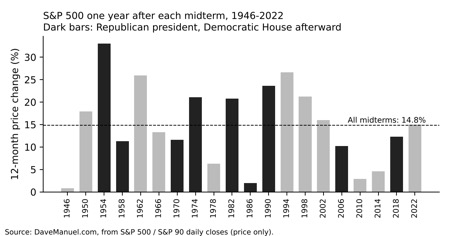
The S&P 500 has been higher one year after every midterm election from one thousand nine hundred forty-six through two thousand twenty-two, twenty for twenty, with an average gain of 14.8%. In the nine cases where a Republican president faced a Democratic House afterward (one thousand nine hundred fifty-four, one thousand nine hundred fifty-eight, one thousand nine hundred seventy, one thousand nine hundred seventy-four, one thousand nine hundred eighty-two, one thousand nine hundred eighty-six, one thousand nine hundred ninety, two thousand six and two thousand eighteen), the average gain was 16.2%, and the weakest result, in one thousand nine hundred eighty-six, was still positive.
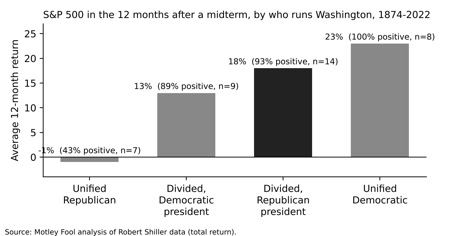
A longer data set tells the same story. Across midterms since 1874, divided government under a Republican president was followed by an average twelve-month return of eighteen percent, positive ninety-three percent of the time over fourteen cases. Unified Republican government, the arrangement voters just ended, is the only configuration that averaged a loss.
A caveat belongs here. Measured over full calendar years rather than the year after the vote, the record of a Republican president with a Democratic Congress is far less flattering. CFRA finds it the weakest configuration, averaging 4.9% a year, and Fidelity’s data show divided government under a Republican president averaging 7.3%. The samples are small, and recessions, wars and Federal Reserve policy did most of the work. History supports a relief rally after the vote. It does not guarantee a good two years.
Speculation: Who Should Benefit
Gridlock does not move every sector equally. The winners are industries that gain from a Congress able to block, investigate and bargain, even if it cannot legislate.
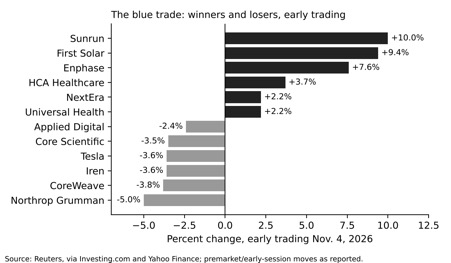
- Health care. Hospital operators (HCA Healthcare, Universal Health Services) and Medicaid and exchange insurers (Centene, Molina, Oscar Health) rallied early. Democrats cannot restore enhanced subsidies on their own, but the 2027 debt-limit vote and annual appropriations give them leverage to trade for health care money.
- Clean energy. Residential solar and solar manufacturing (Sunrun, First Solar, Enphase) and renewable utilities (NextEra) led in early morning trading. A Democratic Congress can protect remaining clean-energy funding through appropriations and oversight, even if it cannot reinstate the 2025 credit cuts over a veto.
- Rate-sensitive sectors. If gridlock means less issuance and lower long-term yields, homebuilders, REITs, regional banks and small caps stand to gain. This is the most direct expression of the inaction trade.
- Gold and precious-metals miners. A weaker dollar and lower real yields are a tailwind, and the morning’s move suggests investors see it that way.
Speculation: Who Should Suffer
The losers are industries whose fortunes depended on a compliant Congress funding or protecting the administration’s priorities.
- AI data centers and neoclouds. CoreWeave, Core Scientific, Iren and Applied Digital fell on the prospect of oversight of the AI buildout and of state and local limits on data center construction.
- Administration-favored companies. Tesla fell 3.6%, and Elon Musk’s companies lost about two hundred billion dollars of market value before the bell. Companies whose valuations depended on proximity to the White House now face House and Senate subpoena power.
- Private prisons and detention operators. These names fell this morning. Immigration enforcement budgets are likely targets in every appropriations fight.
- Oil producers and crypto. Oil weakened on expectations of closer scrutiny of the Iran war, and crypto faces a Congress more inclined to regulate than to promote.
What Could Break the Spell
Inaction is not synonymous with calm. Gridlock in a divided government has produced shutdowns, debt-ceiling standoffs and credit downgrades. The December 11 funding deadline, the 2027 debt limit and a Congress armed with subpoenas all carry the potential for volatility. And lower yields depend on more than politics: as long as the Iran war keeps energy prices elevated, the bond rally has limits. The market is betting that Washington will do nothing. The risk is that Washington, unable to agree on anything, also fails to do the few things it must.
For now, investors have voted. They did not vote for the Democrats. They voted for the stalemate.
| DISCLAIMER: The Rabid Capitalist and all of its associated properties are owned by Cognitor Consulting LLC (“Cognitor”). Cognitor is a publisher of financial information. |
| Cognitor is not a financial adviser. Cognitor does not guarantee the accuracy or completeness of the information provided in this page. All statements and expressions herein are the sole opinion of the author or paid advertiser. |
| THE INFORMATION CONTAINED ON THIS WEBSITE IS NOT AND SHOULD NOT BE CONSTRUED AS INVESTMENT ADVICE, AND DOES NOT PURPORT TO BE AND DOES NOT EXPRESS ANY OPINION AS TO THE PRICE AT WHICH THE SECURITIES OF ANY COMPANY MAY TRADE AT ANY TIME. THE INFORMATION AND OPINIONS PROVIDED HEREIN SHOULD NOT BE TAKEN AS SPECIFIC ADVICE ON THE MERITS OF ANY INVESTMENT DECISION. INVESTORS SHOULD MAKE THEIR OWN INVESTIGATION AND DECISIONS REGARDING THE PROSPECTS OF ANY COMPANY DISCUSSED HEREIN BASED ON SUCH INVESTORS’ OWN REVIEW OF PUBLICLY AVAILABLE INFORMATION AND SHOULD NOT RELY ON THE INFORMATION CONTAINED HEREIN. INVESTORS SHOULD OBTAIN INDIVIDUAL INVESTMENT ADVICE BASED ON THEIR OWN CIRCUMSTANCES BEFORE MAKING AN INVESTMENT DECISION |
| No statement or expression of opinion, or any other matter herein, directly or indirectly, is an offer or the solicitation of an offer to buy or sell the securities or financial instruments mentioned. |
| The author, publisher or insiders of the publisher may currently have long or short positions in the securities of the companies mentioned herein, or may have such a position in the future (and therefore may profit from fluctuations in the trading price of the securities). To the extent such persons do have such positions, there is no guarantee that such persons will maintain such positions. |
| Any projections, market outlooks or estimates herein are forward looking statements and are inherently unreliable. They are based upon certain assumptions and should not be construed to be indicative of the actual events that will occur. Other events that were not taken into account may occur and may significantly affect the returns or performance of the securities discussed herein. The information provided herein is based on matters as they exist as of the date of preparation and not as of any future date, and Cognitor undertakes no obligation to correct, update or revise the information in this document or to otherwise provide any additional material. |
| Cognitor does not accept any liability whatsoever for any direct or consequential loss howsoever arising, directly or indirectly, from any use of the information contained herein. |
| By using the Site or any related social media account, you are indicating your consent and agreement to this disclaimer and our terms of use. Unauthorized reproduction of this newsletter or its contents by photocopy, facsimile or any other means is illegal and punishable by law. |
| Cognitor publishes content through WordPress, an email newsletter platform. By accessing Cognitor’s content, you agree to be bound by the Terms of Use and Privacy Policy, in effect at the time you access this website or any page thereof or any of Cognitor’s content. The Terms of Use and Privacy Policy may be amended from time to time. Nothing on this website or Cognitor constitute an offer to sell, or a solicitation of an offer to buy or subscribe for, any securities to any person in any jurisdiction where such an offer or solicitation is against the law or to anyone to whom it is unlawful to make such offer or solicitation. Cognitor is not an underwriter, broker-dealer, Title III crowdfunding portal or a valuation service and does not engage in any activities requiring any such registration. Cognitor does not provide advice on investments or structure transactions. Offerings made under Regulation A under the U.S. Securities Act of 1933, as amended (the “Securities Act”) are available to U.S. investors ONLY who are “accredited investors” as defined by Rule 501 of Regulation D under the Securities Act well as non-accredited investors, who are subject to certain investment limitations as set forth in Regulation A under the Securities Act. In order to invest in Regulation A offerings, investors may be asked to fill out a certification and provide necessary documentation as proof of your income and/or net worth to verify that you are qualified to invest in offerings posted on this website. All securities listed on this site are being offered by, and all information included on this site is the responsibility of, the applicable issuer of such securities. Cognitor does not verify the adequacy, accuracy or completeness of any information. Neither Cognitor nor any of its officers, directors, agents and employees makes any warranty, express or implied, of any kind whatsoever related to the adequacy, accuracy, valuations of securities or completeness of any information on this site or the use of information on this site. Neither Cognitor nor any of its directors, officers, employees, representatives, affiliates or agents shall have any liability whatsoever arising from any error or incompleteness of fact, or lack of care in the preparation of, any of the materials posted on this website. Investing in securities, especially those issued by start-up companies, involves substantial risk. investors should be able to bear the loss of their entire investment and should make their own determination of whether or not to make any investment based on their own independent evaluation and analysis. |


Leave a Reply